In Germany, your job application is not complete with just a CV. You also need an Anschreiben (cover letter). This document is your first chance to speak directly to the employer. It explains why you are the right person for this specific job. Many migrants focus only on the Lebenslauf (CV) and write a quick, generic cover letter. This is a serious mistake that often leads to rejection.
This guide explains the exact rules for writing a professional German Anschreiben in 2026. We will cover the required structure, the correct tone, and the most common mistakes to avoid. A complete example is included to show you how all the pieces fit together.
What is a German Anschreiben?
The Anschreiben is a formal business letter. It is not a summary of your CV. Your CV lists the facts about your past. The Anschreiben makes an argument for your future with the company. Its goal is to connect your skills and experience directly to the needs described in the job advertisement.
- Purpose: To persuade the hiring manager that you are the best candidate for this specific role.
- Length: Strictly 1 page max.
- Content: It must be tailored to one job and one company. A generic letter will be ignored.
- Format: It follows a strict layout standard called DIN 5008.
The Correct Structure of an Anschreiben (DIN 5008)
A German Anschreiben looks like a formal business letter. The layout follows the DIN 5008 standard, which specifies where each piece of information goes. Using this format shows that you understand professional standards in Germany.
Layout and Contact Blocks
The top of the page contains all contact information. The formatting must be precise.
- Your Contact Information (Sender): Your full name, address, phone number, and email address go in the top left corner or in a header.
- Recipient's Information: The full company name, the name of the contact person (if known) or the HR department (Personalabteilung), and the company's full address. This block sits below your information on the left.
- Place and Date: The city you are writing from, followed by the current date. This is aligned to the right, on the same line as the start of the recipient block.
- Font: Use a simple, professional font like Arial, Calibri, or Helvetica in size 11pt.
- Margins: Set margins to 2.5 cm on the left and 2 cm on the right.
The Subject Line (Betreff)
The subject line is the most important line in the entire letter. It must be clear and informative. It tells the reader exactly what this letter is about. It is always written in bold.
A good subject line includes two things:
- The exact job title you are applying for.
- Where you saw the advertisement, including a date or reference number if available.
Example: Bewerbung als Produktionsmitarbeiter — Ihre Anzeige auf StepStone vom 15.04.2026
Salutation (Anrede)
Always try to find the name of a specific contact person. Addressing your letter to a real person is much more effective than a generic greeting. A generic greeting should be your last option.
- Specific Person (Female): Sehr geehrte Frau [Last Name],
- Specific Person (Male): Sehr geehrter Herr [Last Name],
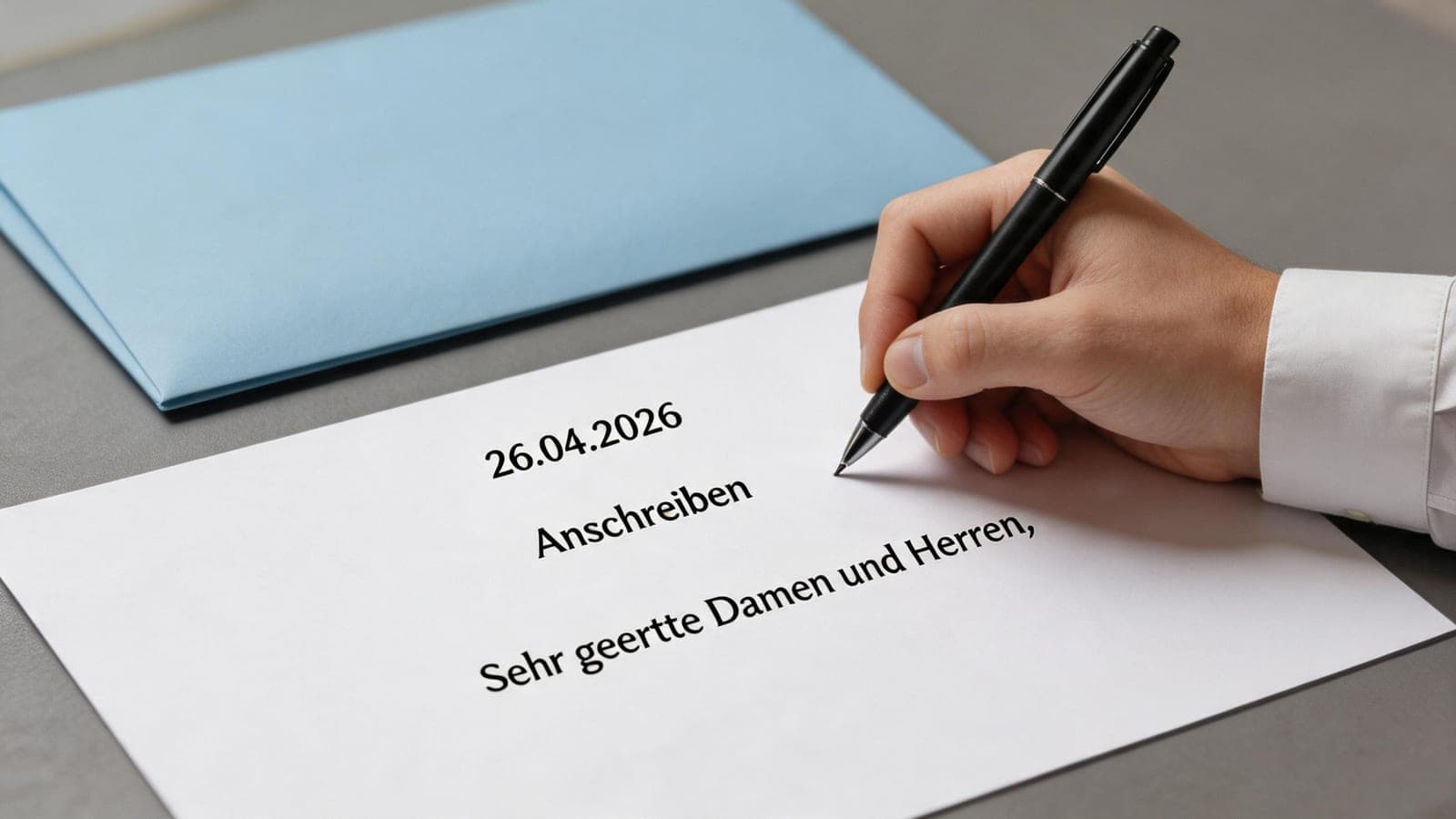
- Generic (Last Resort): Sehr geehrte Damen und Herren,
Note the comma at the end. The first sentence of your letter then starts with a lowercase letter.
Closing and Signature (Grußformel und Unterschrift)
The closing is formal and standard. There is only one correct option.
- Closing Phrase: Use Mit freundlichen Grüßen. There is no comma after this phrase.
- Signature: Leave a few blank lines for your handwritten signature.
- Typed Name: Type your full name below the space for your signature.
If you are sending the application as a PDF, insert a scanned image of your signature.
The Four-Paragraph Formula for a Perfect Anschreiben
A strong Anschreiben has a clear, logical structure. It should be between 250-350 words long and divided into three to four short paragraphs. Each paragraph has a specific job. This formula helps you stay focused and persuasive.
Paragraph 1: The Introduction — Why You Are Writing
Your first paragraph must immediately grab the reader's attention. State the position you are applying for and where you saw it advertised. Then, add one sentence that shows you have researched the company and are genuinely interested. Do not start with weak phrases like 'I am writing to apply...'
Example: ...mit großem Interesse habe ich Ihre Stellenanzeige für einen Produktionsmitarbeiter auf Ihrer Webseite gelesen. Da Ihr Unternehmen für seine hohen Qualitätsstandards in der Automobilzulieferung bekannt ist, möchte ich meine Erfahrung in der Qualitätskontrolle bei Ihnen einbringen.
Paragraph 2: The Core — Why You Are a Good Fit
This is the most important paragraph. Read the job advertisement carefully and identify the top 2-3 requirements. In this paragraph, provide specific examples from your work history that prove you meet these requirements. Use keywords from the job ad. Use numbers to make your achievements concrete.
Example (for a job requiring machine operation and quality control): In meiner letzten Position bei ABC Manufacturing war ich für die Bedienung und Wartung von CNC-Maschinen verantwortlich. Durch meine sorgfältige Arbeit konnte ich den Ausschuss um 15 % reduzieren. Ich bin es gewohnt, nach strengen Sicherheitsvorschriften zu arbeiten und Qualitätsprüfungen nach jedem Produktionsschritt durchzuführen.
Paragraph 3: Skills & Motivation — Why THIS Company
Use this paragraph to mention other relevant skills and express your motivation. This is the place to mention important certificates, language skills, and practical information.
Always include:
- Certificates: Mention your Führerschein (driver's license) or Staplerschein (forklift license) if relevant.
- Availability: State your earliest possible start date (Eintrittstermin).
- Flexibility: Mention your willingness to work in shifts (Schichtbereitschaft) if the job requires it.
- Language Skills: Briefly state your German level (e.g., Deutschkenntnisse auf B1-Niveau).
Paragraph 4: The Conclusion — Call to Action
End your letter with a confident and polite closing. State that you are looking forward to an interview. Do not use weak or conditional language.
Good Example: Ich freue mich auf die Gelegenheit, mich Ihnen in einem persönlichen Gespräch vorzustellen.
Bad Example: Ich würde mich freuen, von Ihnen zu hören.
Example Anschreiben for a Production Worker
The following is a complete example of an Anschreiben. It follows all the rules discussed above. The applicant, Michael O'Connell, is an Irish migrant applying for a job as a production worker in Hamburg. All details are fictional.
vielen Dank für das freundliche Telefonat vom 21.04.2026. Wie besprochen sende ich Ihnen meine Bewerbungsunterlagen für die Stelle als Produktionsmitarbeiter. Ihre moderne Fertigungsanlage und Ihr Engagement für Arbeitssicherheit haben mich überzeugt, dass ich bei Ihnen meine Fähigkeiten optimal einsetzen kann.
In den letzten drei Jahren habe ich als Maschinenbediener bei Cork Industries in Irland gearbeitet. Dort war ich für die Einrichtung und Überwachung von Verpackungsanlagen zuständig. Durch meine genaue Arbeitsweise konnte ich die Einhaltung der Produktionsziele sicherstellen und war Teil eines Teams, das die Stillstandzeiten um 10 % reduziert hat. Die Arbeit im 3-Schicht-System ist mir bestens vertraut.
Ich besitze einen gültigen EU-Führerschein der Klasse B sowie einen deutschen Staplerschein. Meine Deutschkenntnisse sind auf dem Niveau B2 und ich lerne täglich dazu. Ich bin ein zuverlässiger und teamorientierter Mitarbeiter, der auch in stressigen Situationen einen kühlen Kopf bewahrt.
Mein frühestmöglicher Eintrittstermin ist der 01.06.2026. Ich freue mich sehr über eine Einladung zu einem persönlichen Gespräch.
Tailoring Your Tone to the Company
While the structure remains the same, the tone of your letter should adapt to the type of company you are applying to. German companies have different cultures.
- Large Corporation (e.g., Siemens, BASF): Be very formal and professional. Mention their corporate values or market position. Show that you understand how a large organization works.
- Small/Medium Business (Mittelstand): Be practical and direct. Focus on your hands-on skills and how you can solve their problems. Show that you are a flexible team player.
- Family Business: Use a slightly warmer, more personal tone. Emphasize loyalty, reliability, and your desire for a long-term position. Show that you value tradition and a close-knit team.
- Temporary Work Agency (Zeitarbeit): Be very clear and to the point. The most important information is your availability, your skills, and your flexibility. Keep it short and factual.
Common Mistakes Migrants Make (and How to Avoid Them)
Many applications from foreign candidates are rejected because of simple, avoidable mistakes in the Anschreiben. Here are the most common ones:
- Using a Generic Template: Sending the same letter to every company is a guaranteed way to get rejected. Recruiters can spot a generic letter instantly. Always customize it for the specific job and company.
- Overusing the Subjunctive (Konjunktiv II): As mentioned before, phrases like "Ich würde gerne..." (I would like to...) sound weak. Be direct and confident. State what you can do, not what you would do.
- Missing or Weak Subject Line: The subject line must be perfect. If it's missing or vague, your letter might be discarded before it's even opened. Always include the job title and reference.
- Forgetting Key Practical Information: German employers are practical. They need to know when you can start and what qualifications you have. Always mention your availability date, driver's license, and relevant certificates.
- Exaggerating or Inventing Skills: Honesty is critical in Germany. Only list skills and experiences that you can prove with documents or demonstrate in an interview. Lying is grounds for immediate dismissal.
Summary: Your Checklist for a Perfect Anschreiben
Before you send your application, use this checklist to review your Anschreiben.
- Format: Is it exactly 1 page? Does it follow the DIN 5008 layout?
- Customization: Is the letter written for this specific job and company?
- Structure: Does it have a clear introduction, main body, and conclusion?
- Content: Does it answer the main requirements from the job ad with specific examples?
- Keywords: Have you used keywords from the job advertisement?
- Practical Info: Have you included your availability date and relevant certificates?
- Tone: Is your language confident and professional, with no weak phrases?
- Proofreading: Has it been checked for spelling and grammar mistakes, ideally by a native speaker?
A well-written Anschreiben takes time and effort, but it is one of the most powerful tools in your job search. It shows the employer that you are professional, serious, and the right candidate for the job.