Applying for a job in Germany is often a frustrating experience for foreign workers. You may have years of relevant experience, the right skills, and a strong work ethic — yet your applications get ignored. In most cases, the problem is not your background. It is your CV.
German employers do not read international CVs the same way they read a Lebenslauf (the German term for CV). Format, structure, and even small details like date notation matter. A CV that does not follow German conventions is often rejected before a human ever reads it.
This guide explains what a German Lebenslauf must contain in 2026, how to format it correctly, what makes it different from CVs used in other countries, and how to avoid the most common mistakes. At the end you will find a complete example that you can use as a template.
Why German CVs are different
In many countries, a CV is a narrative document. It opens with a career objective, lists roles in flowing sentences, and tries to sell the candidate. The German Lebenslauf works in the opposite way:
- Tabular layout. Dates on the left, information on the right. No paragraphs, no storytelling, no marketing language.
- Reverse chronological order. The most recent role comes first. The oldest role comes last.
- No career objective. Personal goals and motivation belong in the cover letter (Anschreiben), not in the Lebenslauf.
- Strict formatting rules. Most German employers expect documents to follow the DIN 5008 standard, which defines margins, fonts, spacing, and date formats for business correspondence.
- Mandatory signature. The document ends with the place, date, and a handwritten or digital signature on the last page.
- Concise. One page is preferred. Two pages is the absolute maximum.
The required sections of a German Lebenslauf
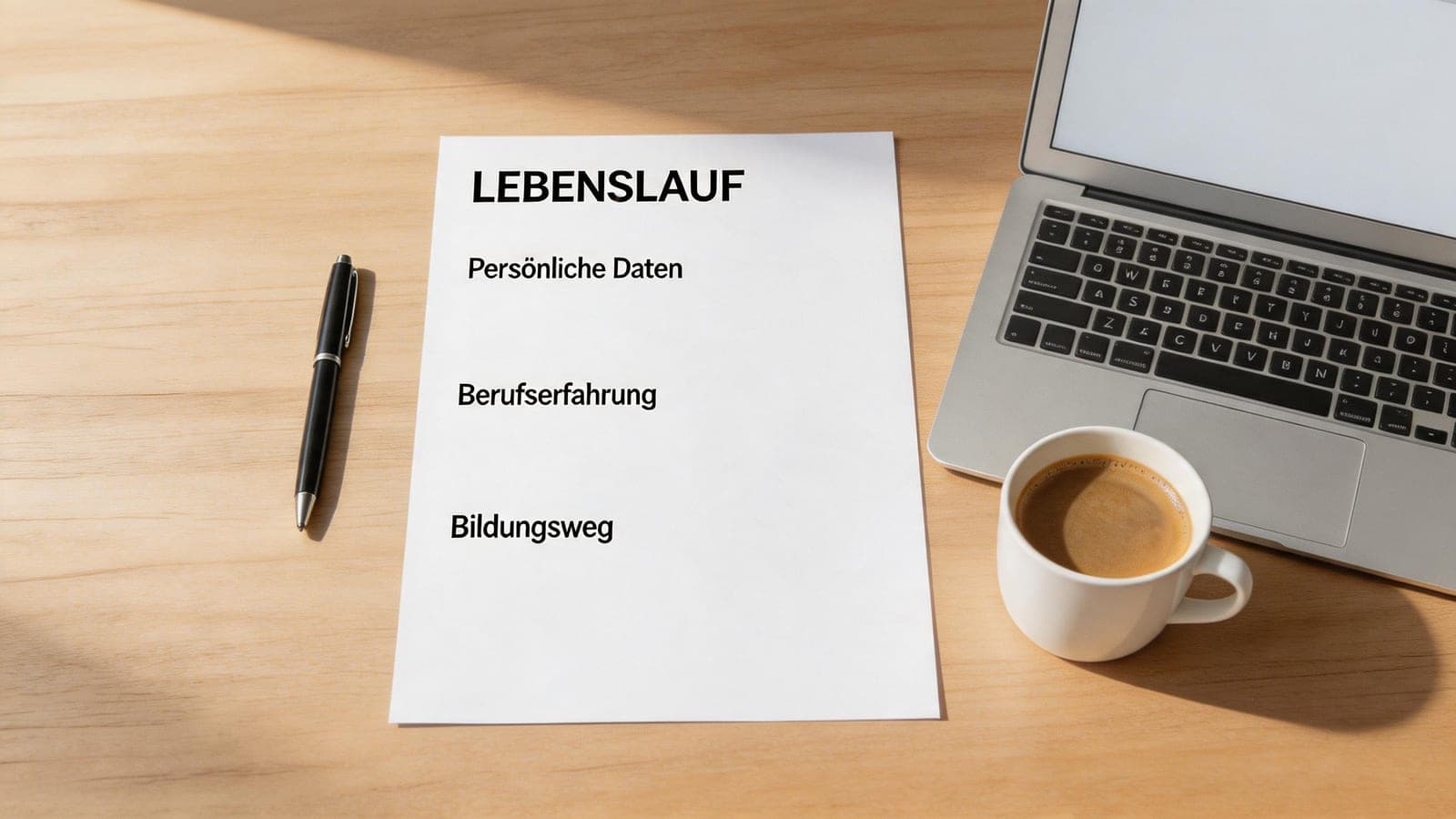
A complete Lebenslauf contains six core sections, presented in this exact order. German recruiters scan documents quickly and expect to find each section in its standard position.
Section 1: Personal data (Persönliche Daten)
Your personal information appears at the top of the first page. It must include at minimum:
- Full name
- Address in Germany (street, house number, postal code, city)
- Mobile number with German country code (+49)
- Email address (professional, not nicknames or jokes)
- Date and place of birth
- Nationality
Marital status, religion, and the number of children should not be included. The German General Equal Treatment Act prohibits discrimination on these grounds, and listing them is no longer considered standard.
Section 2: Photo (Bewerbungsfoto)
Since the AGG took effect in 2006, photos are no longer legally required. In practice, the majority of German employers still expect one. A Lebenslauf without a photo can look incomplete to a recruiter used to seeing photos at the top of every application.
If you include a photo, it must be professional. Take it in a photo studio with neutral background lighting. Wear what you would wear to a job interview. Place it in the top right corner of the first page, sized roughly 4 × 6 cm.
Section 3: Work experience (Berufserfahrung)
For most candidates, this is the most important section of the Lebenslauf. List jobs in reverse chronological order, with each entry containing:
- Date range in month/year format (e.g. 03/2022 – 12/2024)
- Job title in German
- Employer name
- City and, if outside Germany, country
- Two to four short bullet points describing key tasks and results
Bullet points must be specific and concrete. Instead of writing "Was responsible for warehouse operations", write "Managed receiving and stocking of 200+ pallets daily using forklift (Stapler) and SAP inventory system". Numbers, tools, and standards make the bullet point credible.
Section 4: Education (Bildungsweg)
Education also follows reverse chronological order. For each institution, include:
- Date range
- Type of education (high school, university, vocational training)
- Institution name and city
- Qualification or degree obtained
- Specialization or grade if relevant and competitive
If your foreign degree has not yet been officially recognized in Germany, mention it anyway. You can add a note that the recognition process (Anerkennung) is in progress or completed. German employers value transparency on this point.
Section 5: Skills and knowledge (Kenntnisse)
This section covers languages, computer skills, and other professional abilities. Split it into three subsections:
- Sprachkenntnisse (language skills). List every language you speak with a level from the European Reference Framework: A1, A2, B1, B2, C1, C2. Mark your native language as Muttersprache.
- EDV-Kenntnisse (computer skills). List the programs you can use. For most jobs, basic Microsoft Office (Word, Excel, Outlook) is enough to mention. For technical roles, list specific tools and software.
- Sonstige Kenntnisse (other skills). Include your driving license category (e.g. Führerschein Klasse B), forklift certification (Staplerschein), first aid training, or any other job-relevant qualification.
Section 6: Place, date, and signature
At the bottom of the last page, write the city where you currently live, the current date, and your signature. For PDF submissions, attach a scanned signature or use a clear digital one. An unsigned Lebenslauf is considered incomplete by most German recruiters.
Formatting according to DIN 5008
The German business standard DIN 5008 defines the technical rules for professional documents. While not legally mandatory for a Lebenslauf, most employers expect you to follow it:
- Paper size: A4, portrait orientation
- Margins: 2.5 cm left, 2 cm right, 2 cm top, 2 cm bottom
- Font: Arial, Helvetica, or Calibri, 10 to 11 point
- Section headings: 12 point, bold
- Line spacing: single or 1.15
- Color: black for body text, dark blue or grey for headings if used at all
- Maximum length: two pages, ideally one
Example: a complete German Lebenslauf
The following example shows a Lebenslauf for a position as a warehouse worker (Lagerhelfer) at a logistics company in Frankfurt. All names and details are fictional. Use it as a structural template, not as content to copy directly.
• Bedienung von Hubwagen und Handscanner
• Wareneingangskontrolle und Lagerbuchhaltung in SAP
• Schulung von 4 neuen Mitarbeitern in Lagerverfahren
The five most common mistakes foreign candidates make
Working with hundreds of foreign candidates over the years, the same five mistakes appear again and again. Avoiding these puts you ahead of most of your competition before a recruiter has even read the document.
- Translating directly from a foreign CV. The structure must change, not just the language. Drop the career objective. Convert paragraphs into bullet points. Use the German tabular format.
- Vague or missing dates. "2019 to 2023" is not enough. German recruiters want exact months: "05/2019 – 02/2023". Gaps in the timeline must also be acknowledged briefly.
- Unprofessional email addresses. Addresses like
partyboy92@gmail.comorcool.guy.mumbai@yahoo.commake a poor impression. Use your name in a clean format. - Untranslated job titles. German recruiters do not know what a "store associate" or "field technician" is in your home country. Use German job titles, with the original in brackets if helpful.
- No signature. A Lebenslauf without a place, date, and signature at the bottom is considered incomplete. Many recruiters discard such applications without reading them.
What to send with your Lebenslauf
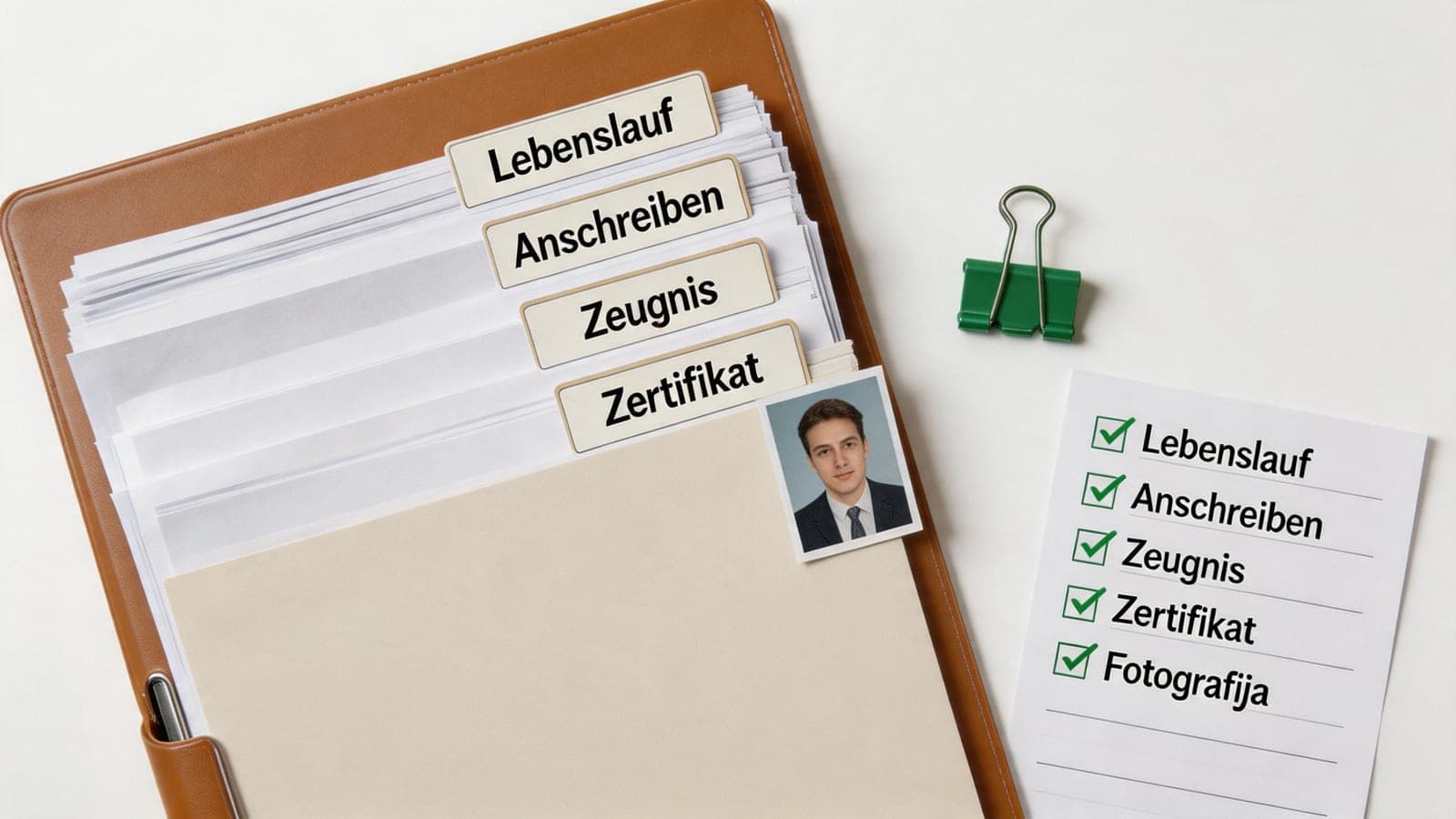
A complete German job application is called a Bewerbung and rarely consists of the Lebenslauf alone. The standard package usually contains:
- Anschreiben — cover letter, one page maximum, tailored to the specific job ad
- Lebenslauf — one to two pages
- Arbeitszeugnisse — work references issued by previous German employers (more on these below)
- Abschlusszeugnisse — diplomas and certificates of completed education
- Zertifikate — certificates from courses, language exams, and professional training
- Deckblatt — optional cover page with your name, the position you are applying for, and your photo
Send all documents as a single PDF file, not multiple attachments. The maximum size German employers typically accept is 5 MB.
Understanding the Arbeitszeugnis
The Arbeitszeugnis is one of the most important and least understood documents in German employment culture. It is a written reference issued by your German employer at the end of an employment relationship. By law, every employee has the right to request one.
For foreign candidates, this matters in two ways. First, German employers usually expect Arbeitszeugnisse alongside your Lebenslauf. If you have worked in Germany before, attach all the ones you have. If you have only worked abroad, attach translated employment certificates instead — they are not equivalent, but they show your work history.
Second, German Arbeitszeugnisse are written in a deceptively neutral tone that hides a coded grading system through specific phrases. This is known as Zeugnissprache. The main grades are:
- "stets zu unserer vollsten Zufriedenheit" — always to our complete satisfaction (grade 1, excellent)
- "stets zu unserer vollen Zufriedenheit" — always to our full satisfaction (grade 2, very good)
- "zu unserer vollen Zufriedenheit" — to our full satisfaction (grade 3, good)
- "zu unserer Zufriedenheit" — to our satisfaction (grade 4, satisfactory)
- "im Großen und Ganzen zu unserer Zufriedenheit" — on the whole to our satisfaction (grade 5, poor)
Summary
A German Lebenslauf follows clear rules that must be respected. It is short, tabular, reverse chronological, contains six required sections, and ends with a signature. The format follows DIN 5008. A photo is not legally required but is still expected by most employers. The document must be in German, regardless of the language of the job ad.
Foreign candidates have a real advantage when they understand these rules. The main reason CVs get rejected is not lack of experience — it is the wrong document structure. By following this guide and using the example as a template, your application is already ahead of most of your competition.